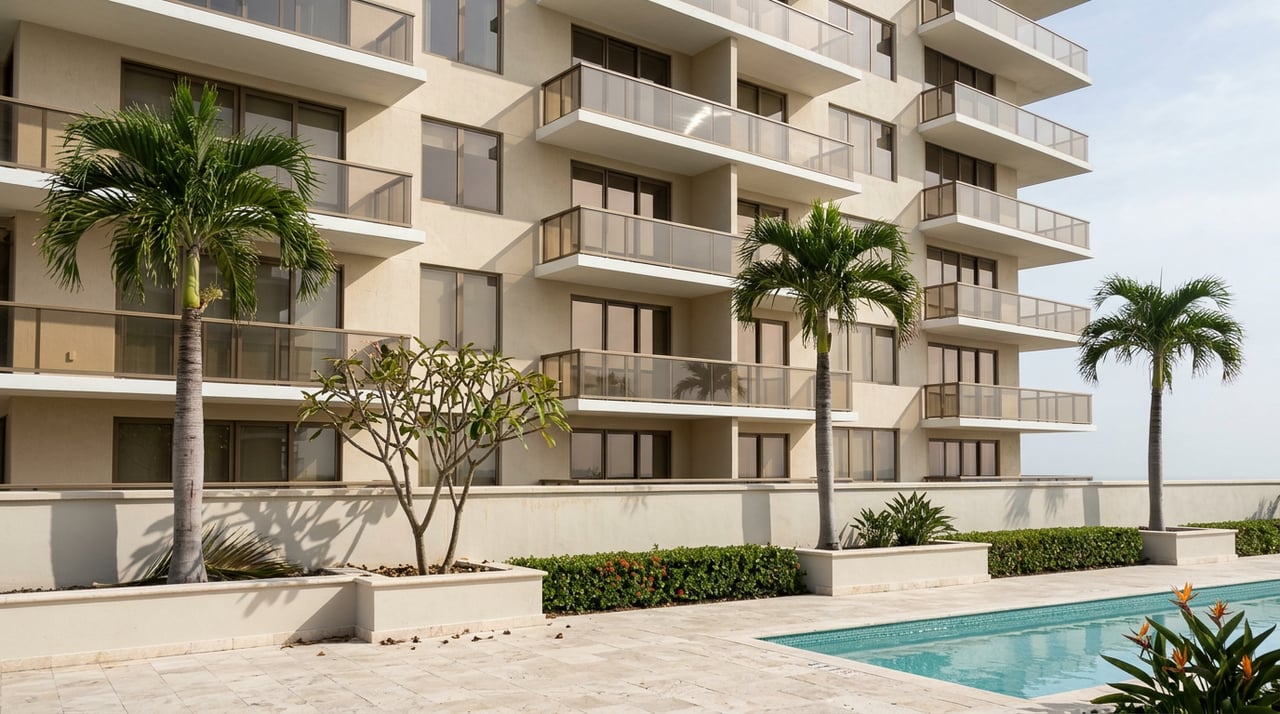
For a Condado tower, the governing documents determine whether short-term rentals are restricted. Under Puerto Rico's Condominium Act, short-term rentals are the default position in every building on the island, permitted unless a specific tower's own bylaws say otherwise. The island did not decide building by building whether to allow short stays. It decided that short stays are allowed everywhere until a board votes to shut the door, and that vote can happen at any assembly, in any building, at any time.
That fact makes the due-diligence question specific: whether the tower you're considering has restricted short-term rentals. Until earlier this year, you had no guaranteed way to find out before you signed.
The Default Rule
Puerto Rico's Condominium Act, Law 129-2020, is explicit on this point: short-term leases cannot be prohibited in a condominium unless the master deed (escritura matriz) or the building's reglamento contains an express restriction, and any council of unit owners retains the power to amend its bylaws at any point to establish, modify, or eliminate that restriction. In plain terms, a Condado tower's stance on Airbnb and Vrbo isn't fixed at construction. It lives in a document that a majority of owners can rewrite whenever they choose to hold a vote.
This matters more in Condado than almost anywhere else in San Juan, because the buyer pool here splits sharply between people chasing rental yield and people who bought specifically to get away from turnover, noise, and guests they don't know. Those two groups do not always agree at assembly, and a building that welcomed short stays for a decade can pivot with a single resolution.
Access to the Governing Document
For most of the life of Law 129-2020, the reglamento existed as a governing document without a clear, enforceable timeline requiring a board or administrator to produce it for a broker or a prospective buyer before closing. You could ask. Responses varied, and a buyer chasing rental numbers on a unit had no statutory lever to force the issue before signing a purchase agreement.
The legislature's own explanation for fixing this was direct: prospective buyers were not guaranteed enough information to make an informed decision. That's the exact language lawmakers used to justify closing the gap, and it tells you the problem was real enough to legislate.
What Changed in January
Governor Jenniffer González signed Law Núm. 13-2026 in January, amending Article 13 of the Condominium Act. The change is procedural but consequential: a condominium's administrator is now required to deliver a copy of the building's reglamento to a licensed real estate broker who holds an accredited listing assignment, or to a prospective buyer who requests it, within five business days. If a building has no administrator on record, that duty falls to the board president or, failing that, the board secretary. Any broker making the request has to be properly licensed under Puerto Rico's existing real estate licensing law.
Five business days is not instantaneous, but it converts a courtesy into an obligation with a clock attached. If you're touring Condado this fall and rental income is part of your math, this is the request you make in writing, on day one of due diligence, not after you've already gone under contract.
A Second Law Affecting Condominium Governance
Roughly seven months later, on August 1, 2026, Microjuris reported that the governor signed a second, larger reform: Law Núm. 157-2026. Where January's law was about access to a document, August's law is about who resolves disputes over what's in it. The reform pulls condominium controversies out of the Department of Consumer Affairs' administrative queue and routes them into new specialized Condominium Controversy courts inside the Court of First Instance, one for each judicial region. It also requires every council of unit owners to set minimum educational requirements before hiring an administrator.
For a buyer, that second provision is the more useful one. An administrator now has to meet a documented minimum standard, set by the board itself. When you're comparing two Condado towers with similar dues and similar amenities, ask what training standard each board has set for its administrator. It won't show up in a listing sheet, but it will show up in board minutes, and now boards are required to have an answer.
Reading Condado's Building Stock Through This Lens
Condado's current construction cycle makes this especially relevant right now. Vanderbilt Residences, the oceanfront tower rising at the corner of Ashford Avenue and Earle Street, is being marketed as the tallest residential building in the San Juan metro area, with units priced from roughly four million dollars into eight figures. A few blocks inland on Wilson Street, CW Tower, designed by architects Ricardo Lefranc and Salvador Alemañy, is bringing another wave of new inventory to the same corridor. Both are stepping into a district where the prior generation's tallest tower, Ashford Imperial on Ashford Avenue, has had years to settle its governance and its rental posture one way or the other.
New construction carries a wrinkle the older towers don't. Under the Condominium Act, a building's Transition Committee, the body that eventually takes governance decisions out of the developer's hands, isn't required to form until 15 days after 40% of the apartments have sold. Until that threshold is crossed, the reglamento a buyer is reviewing may still be a developer-drafted document rather than one that's been tested by an actual council of owners voting on real proposals. If you're buying pre-construction or in the first wave of closings at a tower like Vanderbilt or CW Tower, ask specifically whether the 40% threshold has been reached and whether the Transition Committee has already met. That answer tells you whether the STR language you're reading is settled or still provisional.
What to Actually Request Before You Offer
A short, specific list does more here than a general promise to "review the documents." Before you make an offer on a Condado unit where rental income matters to your numbers, put this in writing to the listing agent or administrator:
- A current copy of the reglamento, citing Law 13-2026's five-business-day requirement
- Confirmation of whether the building has crossed the 40% sales threshold that triggers a Transition Committee, if the tower is still in its early ownership phase
- Any board minutes from the past two years that reference short-term rental policy, proposed amendments, or enforcement actions
- The administrator's credentials and the board's stated minimum training standard, given the requirement introduced under Law 157-2026
- Whether any DACO complaint or new specialized-court filing involving the building is active or pending
None of these questions require a lawyer to ask. They require knowing that the questions exist, and that the paperwork behind them is now something you're legally entitled to see on a timeline.
Frequently Asked Questions
Does this mean every Condado building currently allows short-term rentals? Not necessarily. The law sets the default as permissive, but any building may have already voted to restrict or prohibit short stays through its own reglamento or master deed. The only way to know a specific tower's actual position is to read that tower's own governing documents.
Can a board change its short-term rental policy after I've already purchased? Yes. The Condominium Act allows a council of owners to amend the reglamento to establish, modify, or remove short-term rental restrictions at any point, which is why reviewing recent assembly minutes matters as much as reviewing the current reglamento.
Does Law 13-2026 apply if I'm working with an out-of-state agent who isn't licensed in Puerto Rico? The law specifies that the broker requesting the reglamento must be properly licensed under Puerto Rico's real estate licensing statute, so the request needs to come through a locally licensed broker or from you directly as the prospective buyer.
Condado rewards buyers who read the building, not just the unit. If you're weighing a tower on Ashford Avenue against one on Wilson Street, or a pre-construction reservation against an established address with a decade of board history, HECO PROPERTIES can walk the reglamento, the assembly minutes, and the administrator's standing with you before you write an offer. Request a Private Consultation and bring your list of buildings. We'll help you read what's actually in the paperwork.
This article is general information, not legal, tax or financial advice. Consult a qualified professional about your situation.