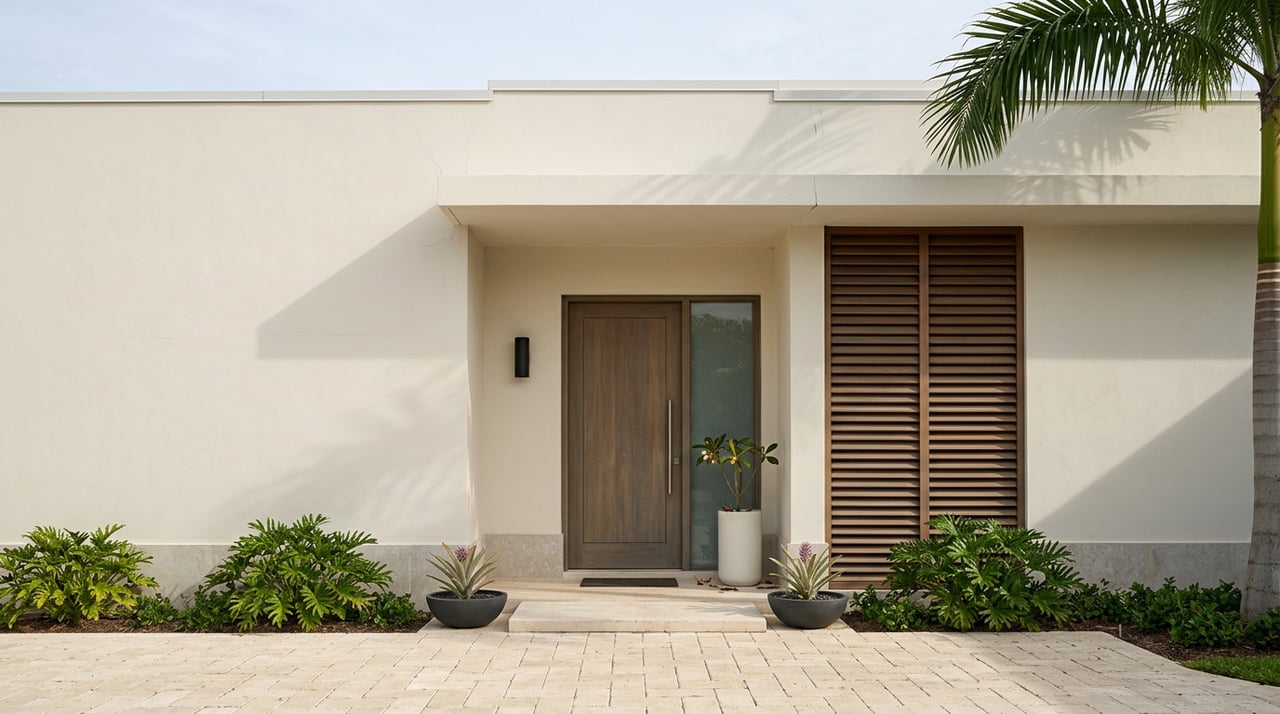
The friction in a Palmas del Mar purchase rarely shows up in the listing photos. It shows up in a single clause buried in the master association bylaws: tenants on leases shorter than six months, along with resort-accommodation paying guests, do not have automatic privileges to the Beach Club and other restricted common properties. That one sentence quietly rewrites the underwriting for any buyer who assumed a $749,000 condo would perform like a Dorado villa on the short-term rental market. The sticker price is the easy part. The dues architecture and the amenity-access rules layered on top are what actually determine your carrying cost and your yield.
If you are comparing Palmas del Mar to Dorado Beach, to Bahía Beach, or to a Condado tower, the median listing is commodity data. What that median buys you inside a 2,750-acre master-planned resort with 32 distinct residential neighborhoods is not.
The six-month rule is the market's real governor
Start with the clause that catches investors off guard. Palmas del Mar operates under the Palmas Homeowners Association (PHA), the master body headquartered at 5 Academy Drive in Humacao, and each condominium or neighborhood regime layers its own bylaws on top. The PHA's declaration draws a line between Common Properties and Restricted Common Properties. Owners and long-term tenants can access the restricted set. Short-stay renters cannot, at least not automatically.
For a buyer running vacation-rental math, that access line is the entire game. AirDNA's Humacao snapshot anchors the market at roughly 55% occupancy and an average daily rate near $238. Those are municipal averages, not Palmas-specific figures, and the resort's amenities are precisely what allow a well-appointed unit to price above the municipal mean. If your guest cannot walk into the Beach Club, your ADR premium narrows. The unit still rents. It rents at a different number than the spreadsheet a mainland buyer built off portal photos.
This is why two identical-looking three-bedroom condos in the same building can produce meaningfully different net yields. One owner sponsors long-stay tenants who use the restricted amenities. The other runs a weekly turnover calendar and prices around the access constraint. The listing photos are the same. The economics are not.
The two dues layers, and why they diverge
Every owner inside the gates pays the PHA assessment. The PHA's new-homeowner guidance lists an annual maintenance fee of $1,300 per residential unit and $1,040 per residential lot, funding security, access control, landscaping, common-area maintenance, and beach cleaning. A separate resort-fee figure of roughly $1,042 per year appears in enclave-level documentation, and the arkrealestatepr.com investor guide cites the same $1,042 figure as the current PHA community assessment. Verify the exact number in your specific closing package, because the master budget shifts and the older PHA schedule may still be quoted in some materials.
On top of that master assessment, each regime charges its own dues. Those regime numbers are where the real spread lives.
| Enclave or format | Typical dues layer beyond PHA | What the layer covers |
|---|---|---|
| Monte Carlo townhomes | No additional HOA fee reported; PHA resort fee only | Master services only |
| Harbour Lakes condos | Regime dues on top of PHA | Building envelope, elevators, pool, corridors |
| Ocean Drive beachfront condos | Higher regime dues | Beachfront envelope, larger pool decks, storm exposure |
| Los Lagos and Candelero villas | Regime or sub-association dues vary | Private streets, gates, landscaping, shared pools |
Christie's cites a common regime range of roughly $100 to $300 per month layered on top of the PHA, though beachfront and amenity-heavy regimes run higher. The practical read: a Monte Carlo townhome and a Harbour Lakes condo can list within $50,000 of each other and carry monthly totals that differ by several hundred dollars once both layers are accounted for. When you underwrite Palmas del Mar, you are underwriting two balance sheets, not one.
What the break-even actually looks like
Work an example. Take a $600,000 two-bedroom aimed at the short-term rental market. Using the market-level anchors, the arkrealestatepr.com underwriting model shows the unit needs roughly $77,000 in gross revenue to break even at a $300 ADR, which implies about 70% occupancy. The Humacao market average is 55%. To close a 15-point gap, you need real amenity access, real view lines, and a management operation that captures the winter and early-spring peaks without giving back the late-summer trough.
Now overlay the six-month rule. If your regime and the PHA together classify your guests as short-stay and restrict them from the Beach Club, the ADR you can sustainably charge compresses. The 70% occupancy target does not move. The rate you need to hit it does. That is why some Palmas del Mar owners quietly reposition toward 30-plus-day corporate stays or seasonal snowbird leases. The rule is not a prohibition. It is a pricing tax, and the buildings that outperform are the ones whose owners planned for it before closing.
Layer in the fixed line items: management at 20% to 30% of gross rent, cleaning at $75 to $200 per turnover, the 7% room-occupancy tax collected by the Puerto Rico Tourism Company, PHA dues, regime dues, utilities, insurance at both association layers, and a maintenance reserve. Many financed purchases in this segment are cash-negative unless the unit outperforms on ADR or the buyer reduces debt exposure.
Storm and sargassum risk sits on both layers
Puerto Rico's east coast carries elevated hurricane exposure. Both the PHA and each regime hold their own insurance policies, with their own deductibles and coverage caps. After a major storm, either layer can levy a special assessment to close the gap between what insurance pays and what repair costs. A buyer who looked only at the monthly dues can be caught by a five-figure assessment two years into ownership.
The PHA's own 2024 HOA analysis flags two ongoing cost pressures worth reading closely. First, sargassum control requires heavy machinery and labor, and the seaweed arrivals vary unpredictably year to year, which means the beach-cleaning line in the master budget is inherently volatile. Second, the analysis calls for a master plan to maintain and repave interior roads, which is exactly the kind of capital project that typically funds through a special assessment rather than the annual dues.
Neither factor should scare a buyer away. Both should shape the offer. A regime with a recent reserve study, a funded capital plan, and a clean claims history warrants a different price than one operating on thin reserves.
The diligence packet that separates a good buy from a surprise
Before you sign, ask for the following in writing. If a seller or listing agent cannot produce them within a few business days, that is itself a data point.
- The current PHA assessment schedule and the regime's most recent budget, with both dollar figures confirmed for your specific unit type.
- The last twelve months of association meeting minutes at both the master and regime levels. Special assessments are almost always foreshadowed here.
- The regime's reserve study and funding policy. A funded reserve is not a guarantee against assessments, but an unfunded one is a near-guarantee of them.
- Insurance certificates for both layers, with coverage limits, deductibles, and named-storm treatment.
- The full text of the PHA declaration and the regime's bylaws, specifically the sections addressing amenity access, guest sponsorship, short-term rentals, and lease minimums.
- Recent claim history, especially any open post-storm items.
- FEMA flood-zone determination and, where relevant, a current elevation certificate.
If you plan to rent the unit, add the PRTC innkeeper registration and the last twenty-four months of booking statements and payout reports. Calendar screenshots are marketing. P&Ls and 1099s are underwriting.
The bottom line
The reason experienced Palmas del Mar buyers negotiate differently than first-timers is that they price the two-layer dues structure and the six-month access rule into the offer before they walk the unit. The median listing tells you what the seller wants. The master and regime documents tell you what you will actually own. Between the two sits every dollar of the carrying cost and most of the yield.
If you are weighing a Palmas del Mar purchase against a Dorado villa, a Río Grande resort condo, or a Condado tower, and you want the dues architecture, the regime-level rental rules, and the recent transaction comps read out loud in one sitting, HECO Properties will walk you through it before you write an offer. Request a private consultation and we will send a diligence packet template you can hand to any listing agent on the island.